
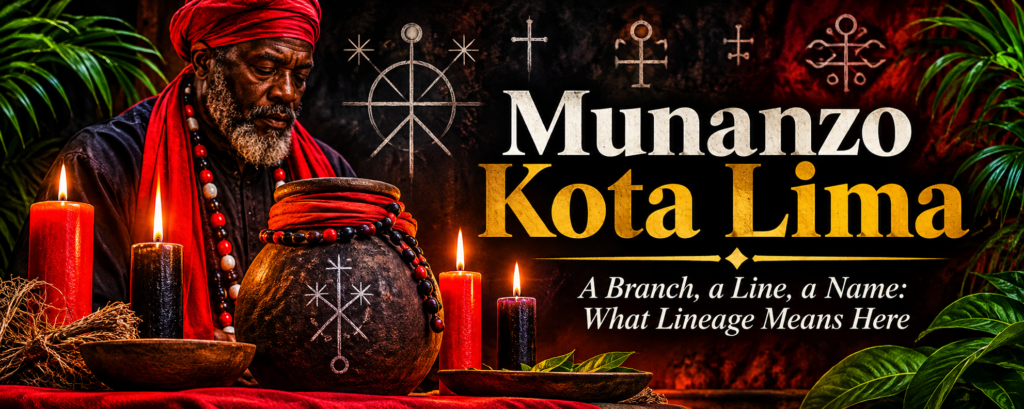
Branch, House, and Lineage
You can open almost any corner of the internet and find someone teaching spiritual work with total confidence. The voice is steady. The claims are large. The followers are many. Ask that person simple questions and the confidence falls apart. Who taught you? What house do you belong to? What lineage does your teaching come from? Most of them cannot answer. They learned from a book, from a video, from a feeling, from no one they can name. A teaching with no teacher behind it is just opinion wearing a robe.
The internet rewards a certain kind of polish. It rewards clear speech, good lighting, and the appearance of authority, and none of those things cost the person anything to produce. A stranger can read three books, watch a hundred videos, and step in front of a camera tomorrow sounding like an elder. Nothing about the performance will warn you. The warning comes only when you ask where the knowledge came from and who vouches for the person carrying it. That is the question the polished ones avoid, and it is the one that matters most.
This is why branch, house, and lineage matter. A branch is the living body of a tradition as it passed through a people and a place, shaped by the language they spoke and the ground they stood on. A house is the specific community that holds and guards that teaching, the elders who set its rules, and the standards it keeps for who may teach and who may not. A lineage is the chain of teachers who carried it forward, one set of hands to the next, named at every link so the chain can be read.
When those three are named and checkable, a teaching becomes accountable. You can trace it. You can question it. You can hold it to something outside the person standing in front of you. A branch that no one in the tradition recognizes, a house that exists only in one person’s mouth, a lineage that starts the moment someone picks up a camera, these are the marks of a teaching built to be admired and never inspected. The names are what convert a claim into a fact you can test.
My own teaching comes from the house Munanzo Kota Lima, as taught to me by Tata Luisito Viento Malo. I do not name anyone above my teacher. I do not need to. Those who seek to verify who I am can just mention his name and mine.
A chain does not break because a link has finished its work on earth. The authority lives in the chain and the record, in names that can be checked and a history others in the tradition can confirm. A house head stands inside that history. He does not float free of it. The names he gives you are names held by living elders and by the dead who carried the teaching before him, and any honest person in the wider tradition can confirm that chain, or dispute it, when they are asked.
A man whose teacher has died is not a man answering to nobody. Tthe dead can and do still hold him to account. That is the whole point of a lineage. It does not require a living hand resting on the shoulder of the one who teaches. It requires a record that outlasts any single life and binds the teacher to people and places he did not choose for himself.
For a beginner, this is not trivia. It is protection. You cannot examine what has no name. You cannot check what no one will claim. But a branch, a house, and a lineage can be traced, and tracing them tells you whether you are standing in front of a teacher or in front of a performance. The person who can give you the names is handing you the means to test them, and that is the first sign you are standing in front of a rightful elder and not a performer pretending to be an elder.
So ask any teacher you meet for their branch, their house, and their lineage. Ask for the names. The ones who can answer you plainly are the ones worth your time. The ones who cannot, or will not, have already told you everything you need to know. Everything needs roots and if they cannot provide you with the roots of where their authority came from, then they have no authority.

