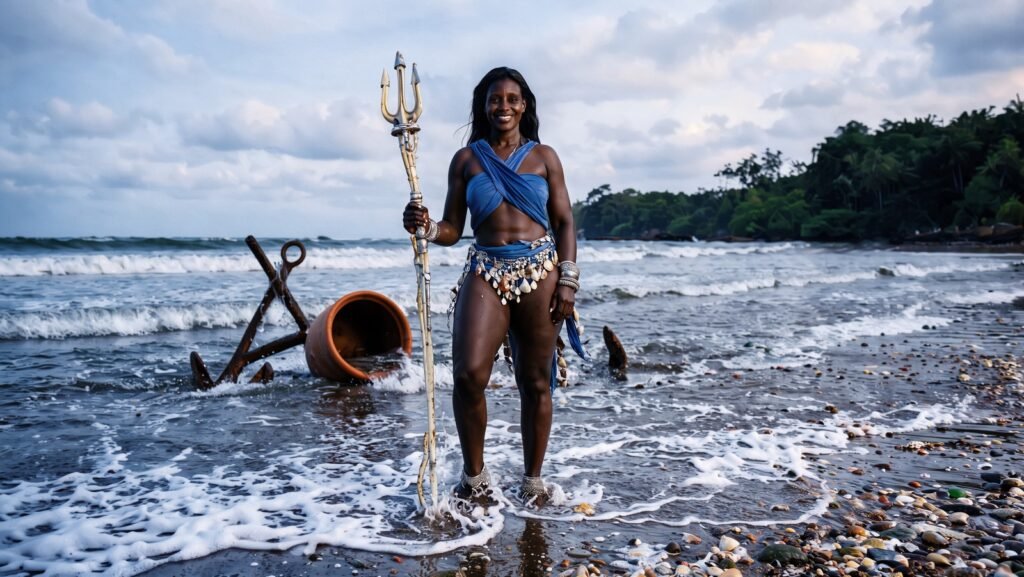
Kalunga, also called Madre Agua, is the Mpungu who governs every sea, every ocean and every body of salt water. She is the barrier between the world of the living and the world of the dead, and she is the water a person crosses at the end of their life. Your own hub calls her overlooked, and that is hard to argue with once her role is laid out.
Madre Agua, and the names she answers to
Her name is Kalunga. She is also called Madre Agua, Madre Lango, Madre Mundo and Baluande, and Mama Kalunga is the familiar form. Every one of them names the same Mpungu.
Her origins are in Kongo myth, long before Cuba. The old myths describe her as the Mpungu who rules the ocean, the seas, and the border separating the living from the ancestors.
The line between the living and the dead
In Kongo cosmology the two worlds are not separated by distance. They are separated by water, and that water is hers. When Nzambi a Mpungu separated the waters from the sky, Kalunga was designated as the barrier that keeps the land of the living apart from the land of the dead, and that role was given to her to maintain balance.
The cosmogram marks the same thing. The Kalunga line on the Dikenga is the separation between what is seen and what is unseen. Above the line is Ku Nseke, the land of the living. Below it is Ku Mpemba, the land of the spirits, the ancestors and the unborn, sitting beneath her water. Ku Mpemba is both a tomb and a womb. It holds the souls of those who have shed their bodies, and it is the canal those souls travel back through when it is time to be born again. Before a person is born, that is where their soul waits.
That line makes her the veil. It is also the reason this House does not hold with the idea of the veil thinning. Kalunga does not weaken, and the barrier she holds does not wear down. The line is the same today as it was when it was set.
Her water is crossed in both directions. Everyone who is born must cross her waters to be living, and everyone who passes away must cross her waters to enter the afterlife. Nobody arrives in the land of the living without her and nobody leaves it without her.
Where the two worlds sit in relation to every other order of spirit is set out on the cosmology page.
The path the spirits travel
Lucero opens the door between the worlds. Kalunga is the path the spirits walk once the door is open, and the road they travel is her water.
That is why she is described as one of the most important aspects of the cosmology and not simply as one of the more important Mpungu. Nothing crosses between the two worlds without crossing her.
The mother of the world
Every sea and every ocean is her domain, which is why she is widely called the mother of the world. Her energies are found at the beach and at any body of salt water.
She shares the water with one other Mpungu and the two are not to be mixed. Chola Nguengue holds what is fresh and running, the rivers and the streams. Kalunga holds the salt, the oceans and the crossing.
Her temper is the ocean itself
Her nature is described as cool, and she is the one who cools even the hottest of hot heads. That word does her an injustice if it is all a person hears. The ocean is calm until it is not, and she carries the same potential. She can become volatile and destructive when she is approached incorrectly or neglected, and the tsunamis, the hurricanes and the tropical storms are hers.
She is approached for children
She is the mother of the oceans and she loves and protects children, which makes her the Mpungu a house turns to for pregnancy. Expecting mothers approach her, and so do people dealing with infertility who are trying to conceive.
Blue, and what she takes
Her color is blue. She takes blue flowers, blue fruits, watermelon and rum.
The confusion with sirens and mermaids
She is often tied to sirens and mermaids, and she is not the only Mpungu who is. That association carries more of the imagination of the outside world than it carries the tradition, and the water spirits people describe are not what they have been made out to be. The subject has a page of its own.
The crossing at the end of a life
When a practicing member of the tradition reaches the end of their journey among the living, they begin the journey among the dead by crossing Kalunga’s waters. The dead return to the land beneath her water, and the beach, which is one of the seven places a person is brought to meet the Mpungu during presentations, is hers.
That crossing is the standard she holds everyone to. Even the pact a Tata makes with the spirit housed in his Nganga lasts only until the day he sheds his body and returns to the land of the dead beneath her great waters.