
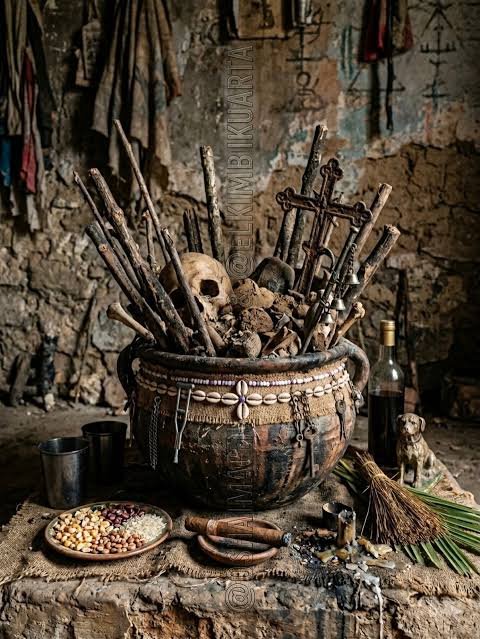
Somewhere along the way, a stranger decided for you what Palo Mayombe is, and they decided it in a language of fear: curses, darkness, and a door you were told never to open. I am the head of a house in this tradition, with a written record that begins in 1815, and I am here to tell you that the stranger was wrong. Not partly wrong; wrong at the foundation. What people call Palo Mayombe is a spiritual tradition of the Kongo peoples, carried through Cuba into the present day, and its core work is not harm. It is relationship: with the dead, with the lineage, with the land. In this essay I will show you where the fear came from, who profits from it, and what the tradition actually does, from a house that can prove where it stands.
Palo Mayombe is an African Traditional Religion dating back thousands of years brought to Cuba via slave trade, as early as the 1500’s. From Cuba it has spread to many countries around the world. With the invention of the internet, it gained traction among online communities like discussion platforms, email lists, and Usenet groups as early as the 1990’s. Later, in the early 2000’s, it spread to online libraries like Scribd. While the internet helped the religion spread and gain visibility on a world stage, it also gave the wrong people access to previously private information. This information would then be corrupted, improperly used and published to create sales strategies. The main selling point has become one of Palo Mayombe becoming the monster under your bed that you should be afraid of. This serves two sales strategies; it creates a boogeyman people can blame to sell services to unknowing non-initiates to rid themselves of said boogeyman, and the bad reputation creates interest in customers wanting to purchase curses and hexes for their enemies from practitioners.
Palo Mayombe is actually not what the internet has made it seem to be. This religion is one of love, or protection, of survival, of liberation. Though this religion has evolved out of necessity, and has the tools that can be used negatively, it is not inherently negative. The truth is any religion can be misused to justify and perform negative acts. This one will not be the exception to that. What people take and misuse were concepts and tools meant to liberate, save and protect the people. In misusing the tools of the religion, people have tarnished the reputation and made it into a monster that they can better sell, because fear sells.
In traditional practice, the dead or spirits, are understood and approached as family. In the corrupted, fear-inducing, fictional belief, the dead are a weapon wielded against everyone who crosses you. What people often overlook is the relationship we share with the dead. The corrupted story would have you believe that our forefathers, our ancestors were these evil sorcerers and their spirits are now evil too. Where the traditional belief is that they are normal people, they would do anything for the sake of their descendants as normal people do. This is not out of hatred for others, but loved for their own.
How you differentiate between a legitimate practitioner versus a service provider is by asking questions, making observations and using your own discernment. There are several questions that can be asked to establish whether a person is legitimate or a fake.
- What house are you from?
- When were you initiated?
- Who is your elder?
These questions are hard to answer for someone who is not really a practitioner and are just a few of a long list of questions that can be asked to establish validity of an elder.
Making observations is also something that tends to reveal a real practitioner versus a fake or service provider. Nothing is as efficient at revealing someone’s true intentions than their own body language. Nothing tells you more about a person and their true beliefs like watching them. They may hide their negativity behind pretty words but their actions speak louder than any words. This is because in the battle for the truth, words may sometimes ring true, but actions never lie.
Using your discernment does not mean to pretend to know what you do not know. It means to take all available information and make an informed decision. Ask questions, observe them, think about their responses and see if they align with your beliefs. Sometimes things just have to make sense. If they are not making sense, you have to ask yourself “but who stands to gain from my confusion?” If the answer is them, your discernment has pointed you away from them, not towards them. Believe in your discernment, follow it, it will lead you to the right places.
If you have made it to the end of this article, thank you.
Tata Rompe Pecho

