
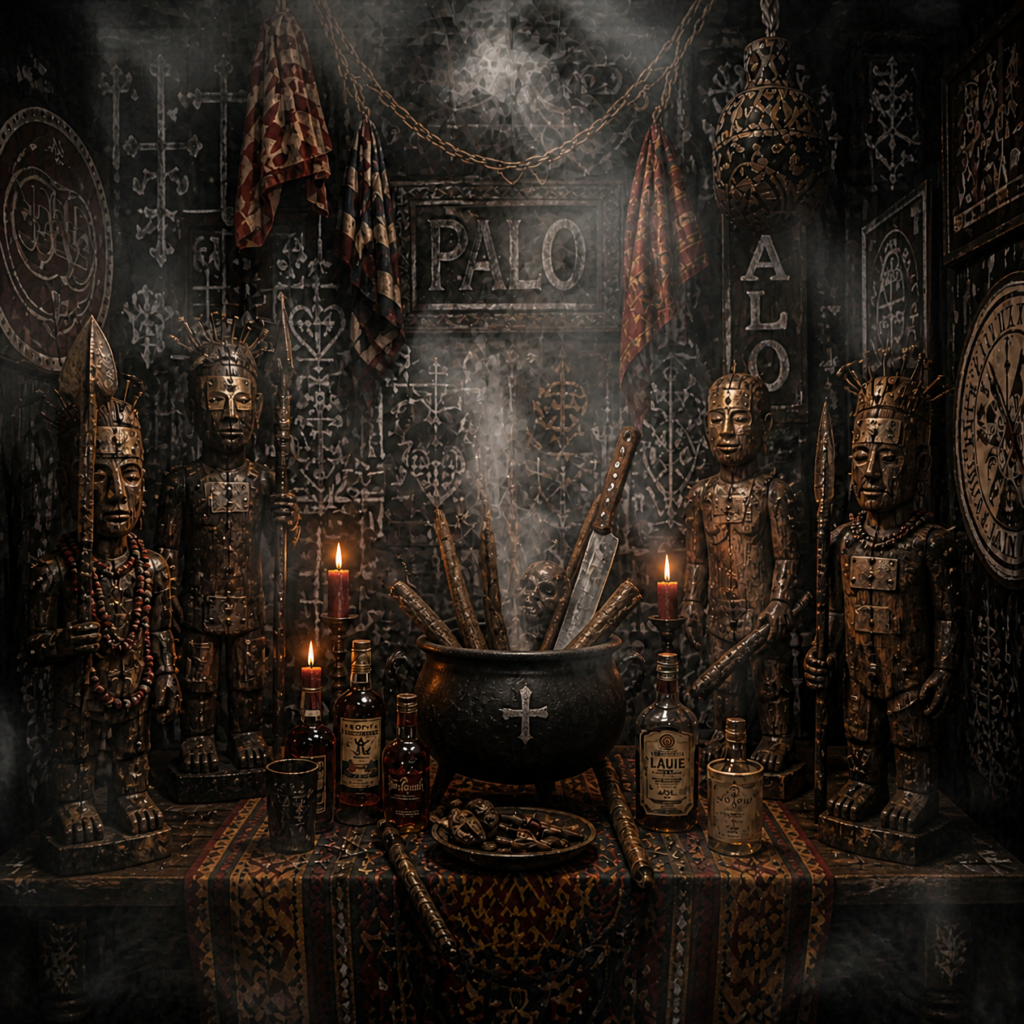
The Questions I Would Ask Any House, Ours Included
Anyone can build a website and call it a temple of Palo Mayombe. A domain costs twelve dollars. A stock photograph of candles and a clay pot costs nothing at all. A biography written in one afternoon can borrow the words of men who died before the person writing it was born.
I have seen this done. I have watched strangers assemble a storefront of borrowed authority and open it for business inside a week. The claims are cheap, and the pictures are cheaper. What costs something is a record, a named teacher, and a practice that other people in the tradition can confirm.
So I want to write this the way I would want it written for me. If I were a stranger standing outside a house I had never seen, and the door opened to someone I could not vouch for, I would ask questions. Not hostile questions. Plain ones. The answers would tell me almost everything, because the truth is heavy and a lie is light.
In this article I will walk through the questions I would put to any house if I were the stranger looking in. I will put them to my own house too. A standard that applies to everyone except the man holding it is not a standard. It is a shield. And I will say plainly what a real answer sounds like and what a dodge sounds like.
The first question, and why it is about teachers
The first question I would ask any house is not about spirits. It is not about the tools on the altar or the number of people who show up to the ceremonies. It is this one. Who taught you.
Everything else can be faked or borrowed. A title can be printed. An account can be created overnight. A manner of speaking can be copied from better men. The answer to who taught you is different, because it is a chain, and a chain either reaches back into other hands or it does not. A man who cannot name his teacher is either hiding something or standing on nothing, and both are good reasons to keep your money and your trust in your own pocket.
I cannot stress enough how central this question is. In every traditional religion that requires initiation, the authority to lead does not belong to the person. It is passed. It moves from hand to hand, from an elder to a student, across years and often across borders and oceans. A house is a link in something old. The authority in it does not originate with the man leading it this year. It was handed to him the way it was handed to the one before him, back through a long row of hands that are mostly gone now.
Palo Mayombe did not survive by accident. Its origin lies in the Kongo, in the forest traditions of central Africa, and from there it was carried across the Atlantic in the holds of ships, in the bodies of people who were forbidden to keep it. It was hidden under other words in colonial Cuba and kept alive in the countryside and the cities by people who carried it in their memory because they were not allowed to write it down. A practice that old is not invented by a website. It is received. The day a man cannot tell you from whom he received it, he has told you that he received it from no one.
So I would ask. Who is your teacher. Not the title he holds. His name. Where is he. How long did he train you. Whose student was he. And is he living, or has he passed.
That last question matters less than most people think, and I will come back to it at the end, because a lie runs through the spiritual world that a teacher who has died makes a student illegitimate. That lie is usually told by people who need it to be true. Hold it in your hand for now.
Names, years, and what can be checked
A real answer to the first question produces a second set of facts on its own. A name. A place. A stretch of years. A teacher and a student meet somewhere on this earth in real time, and that meeting leaves a mark that other people remember.
When a man tells me the name of the elder who made him, I should be able to find that name in more than one mouth. I should be able to find people who knew the elder, who met him, who stood in the same room while he worked. I should be able to find the student standing beside the teacher inside someone else’s memory. The tradition keeps its records in the memories of its members, and those memories agree with each other, because they are describing something that actually happened.
The vague answer is the one to distrust. “I was initiated many years ago.” Many years ago where, and by whom. “My teacher was a powerful man.” Powerful is not a name. “He preferred to stay hidden.” Some elders do keep a low profile, and that is real. A low profile is different from an empty page. Even a hidden elder was present at his own ceremonies. Someone fed him. Someone watched him. Someone in the tradition can still say his name out loud.
Silence about a teacher is sometimes honest. The dodge is different. The dodge is a teacher who cannot be reached by any road, not by name, not by place, not by the testimony of anyone else who shares the path. A name no one has heard and no one can confirm is not a quiet elder. It is a blank space with a title painted over it.
I would also ask about years, not the exact hour but the span. How long were you with him. A real apprenticeship takes time. In most traditions it takes years, and it takes longer than a season by a wide margin. When a man says he was made and raised to lead inside a few months, he is telling you his teacher gave away authority faster than the tradition has ever given it away. Put that number next to how long everyone else spends, and the gap will tell you what you need to know.
Here is how the checking actually works out loud. Nobody has to interrogate a man like a court. You find the others. You find the person who was initiated beside him. You find the elder two cities over who remembers the same names. This world is small enough that the truth travels, and the men who carried real authority left a trail in the people they touched. A chain that is real will ring true in several places at once. A chain that was invented will only ever be confirmed by the man telling it and by the accounts he wrote or paid for himself, and both of those things are the same single voice wearing different clothes.
What a record is and what a story is
These two things are easy to confuse, so let me separate them.
A story is something a person tells you. It can be beautiful, and it can be moving, and it can still be invented. Fraud is not built on clumsy lies. It is built on good stories, because a good story is the one thing that requires no teacher, no years, and no witnesses. The storyteller can manufacture a whole biography out of air and deliver it with a straight face and perfect confidence.
A record is different. A record points at other people. It names the teacher, the year, the place, the ceremony, and the witnesses who were present when it happened. A record can be checked by someone who was not in the room with you, because the story connects to facts that exist outside the teller. When I hand someone a claim, the question I want them to ask is not whether it sounds true. It is whether it can be traced to a source I do not control, that is lineage.
This is why a house that is real does not mind the checking. It invites it. A real record welcomes a second set of eyes, because the record was not made for the audience in the first place. It was made by living it, and the living left marks that others can find.
For most of its history this tradition kept no paper at all, and that is not the weakness a modern reader might assume. Oral systems across Africa and the diaspora carried genealogy and law and history for generations with more accuracy than a filing cabinet, because the keepers were trained for that work and the community held them to it. Memory was the archive. So when I use the word record I do not only mean a certificate a man can print on nice paper. I mean the living archive that is the body of elders who remember, and that archive either contains the name or it does not. Paper can be faked. A room full of people who were present cannot be.
The fraud works in the other direction. He wants the story to stand in for the record, and he wants you to accept the story on feeling alone. He will tell you the details are too sacred to share. He will tell you that verification is a lack of faith. What he will not do is point you at a name you can look up and a person you can reach.
The difference between a title and a duty
A title is given. A duty is carried. From the outside these look like the same thing, because the fraud sells the title and hides the duty.
A man can call himself Tata. The word is old and honorable and it means a father, an elder, a head. Anyone can type it in front of a name. What the title is supposed to point at is the duty, and the duty is where the weight lives. A head of a house is the one who answers when a member cannot sleep for what is following him. A head of a house sits with a family through a death. He takes responsibility for the people he has received, and the responsibility does not disappear when the request is inconvenient or the person has nothing to give.
So I would ask a house what it does for its people when there is nothing to gain. What happens when a member is in trouble at three in the morning. What happens when someone cannot pay. What happens when a person inside the community is wrong, and the wrong is inconvenient to the leaders. Those answers describe the duty. A house that leads with its titles and cannot describe its duties is selling the coat without the man inside it.
I have seen cases where the title was everything. The certificates, the photographs, the borrowed grandeur. Behind it, not one member could say the first thing the head had ever done for them. Authority that never turns into work for another human being is not authority. It is decoration. And decoration costs the buyer everything, because it looks like safety right up until the night you actually need help.
How to read a refusal to answer
Not every question gets answered, and not every unanswered question is a crime. A real house keeps some things private. The ceremonies are private. The names of certain dead and certain tools are private. The deep work is private. There is a difference between a mystery and a stone wall, and learning to hear it will save you money and grief.
A mystery comes with a boundary and a reason. “That belongs to the ceremony, and I cannot speak of it outside.” That is fair, and I would not want a house that spilled its sacred work to any stranger at the door. A mystery points inward and says this is protected, not hidden. The line is drawn so the sacred stays whole, and it is drawn the same way for everyone.
A dodge comes with a boundary and no reason, or with offense. Watch how a man reacts to the ordinary questions, the ones about teachers and years and records. A real house answers those plainly and without heat, because there is nothing to hide. The plain question is the one the fraud cannot survive, so he treats it as an insult. He will tell you that asking is disrespect. He will tell you that doubt proves you are not ready. He will turn the question back on you and make your caution into the problem.
When a man cannot answer a simple question about his own teacher and then blames you for asking, you have your answer. It is not the answer he would have chosen. It is the honest one.
Turning the same questions on this House
Now the part that the people who write articles like this almost never do. I will ask these questions of my own house, in my own name, so the standard holds me too.
Who is my teacher. His name is Tata Luisito Viento Malo. He initiated me on June 6th, 2006 in Miami, Florida. He had me study under him until October 15th, 2015, where he officially acknowledged me as a Tata Nganga and elder. During those years of study, he taught me and performed many ceremonies on me which I cannot name publicly. He is the man who made me and from whom my authority comes. He gave me authority to initiate and teach others, when he gave me the signs and seals for each kind of initiation. I regretfully acknowledge that he has passed from this world, because he was my everything. He was my elder, my teacher, my brother, my best friend and when he passed, I lost all of those people at once. Still, I carry his name forward, and I answer for what I do with what he gave me. I aim to carry his name and memory with dignity and honor so that future generations can know of him and his teachings. I aim to be the younger brother that stands in the face of the world and refuses to let his older brother be forgotten. Through me, those who knew him personally, will attest that they can still feel his presence, his love, and his warmth.
Does a teacher who has died leave a student illegitimate. No. This is the lie I named at the start, and I will end it here in plain words. Legitimacy was never a living body standing behind the student. Legitimacy is a named and checkable chain of teachers, living or dead, that other people in the tradition can confirm. When my teacher died, the chain did not break. The chain is what he was, and I am the next link, and the links before him are known. A man is not fraudulent because the man above him has died. A man is fraudulent because no one can check the chain at all.
Understand why that lie gets told. If a dead teacher made a student fake, then every student whose elder has passed would be fake, and every one of them would have to go find a living person to stand above them and bless them back into business. The people who spread the lie are usually selling exactly that, a living signature. They need the dead to be worthless so that they can be necessary. Do not hand them that. A verifiable chain does not stop being verifiable because the hands at the top have closed.
What a record is, here. The record is the name of the teacher, the years of training, the ceremonies that were held, and the people who were there. None of that was written last month to fill a page. It happened in rooms with witnesses, and those witnesses are the record as much as any document. I do not ask anyone to take my word over the word of the tradition. I ask them to check the name against the people who knew him.
The history of this House belongs to that record too. It is the history of the people who were made here, the ceremonies held here, and the years spent working under the hand of the tradition. I do not ask anyone to take the history of this House on my word alone. I ask them to measure it against the same witnesses that measure everything else.
What our duty is. We teach people to stand on their own feet. That is the whole purpose of this house, and everything else serves it. We do not want members who cannot function without buying something from us every month. We want people who learn the tradition well enough to carry it, and the day a student can carry it without us is a day we count as a success, not a loss. We reserve the right to remove anyone who brings harm into this space. We hold that line without apology, because a house that protects no one protects nothing.
The readings we give are divination. They show a person what is moving around them and what to do about it. A reading is meant to send someone away standing on their own feet, and that is the difference between a service that teaches and a service that keeps a person coming back for the rest of their life.
Where we keep a mystery. The deep work stays behind the door. The ceremonies are not for a stranger reading a website, and I will not perform them for an audience. What is public is what has always been public. The history, the shape of the tradition, the services we offer, and the corrections of what has been said falsely about all of it.
Judge me by the same rule I just used on everyone else. Check my teacher. A deceased teacher is not a broken chain. An unverifiable chain is the only real fraud signal. If the chain can be confirmed by people inside the tradition, the house is real. If it cannot be confirmed by anyone, walk away and keep walking.
What to do with all of this
This article was not written as a weapon against other houses. I have no interest in that fight. I do not check other houses work, I do not talk negatively about other houses either. I wrote it for the person standing outside, the one with the questions and no one to ask them to, the one who is afraid of being fooled and equally afraid of walking past something true.
So take the questions with you. Ask for names. Ask for years. Ask what a house does for its people when there is nothing left to gain. Ask whether the chain of teachers can be confirmed by anyone besides the man telling you the story. Then listen to the answers, and listen just as hard to the refusals.
The truth is heavy and it is easy to carry, because it points at other people, and other people can be found. A lie is light and it travels fast, and in the end it always points at no one. When the chain goes quiet and empty, and the man tells you to trust him instead, you already have the only answer you need.

