
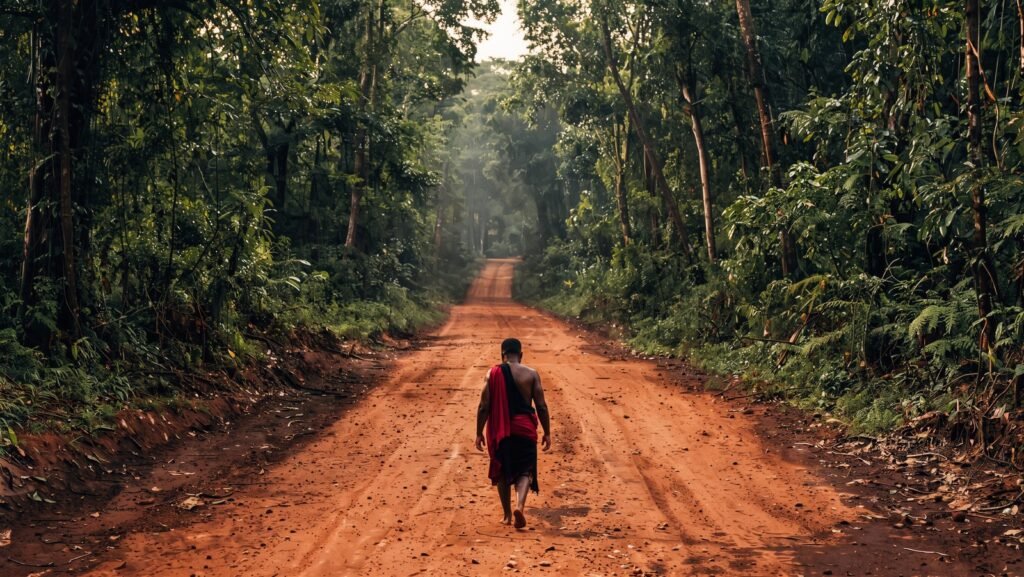
Lucero is one of the Mpungu, the gods of Nkisi Malongo (Palo Mayombe). He is the first one a person meets, whether or not they know it, because he is the spirit a house speaks to before any other. He is the messenger, the keeper of the crossroads, the witness who keeps the record of a life, and one of the four who sees a person through the end of it. In the Kongo he is Nkuyu Nfinda. The name Lucero was given to him in Cuba, and it means the morning star and the one who brings the light.
The names he answers to
Nkuyu Nfinda and Nkuyu are among the Kongo names he answers to. Nfinda translates to forest, so the forest is carried in his name. Tata Nfinda is used as a term of respect. Lucero Mundo is the Spanish form. Lucero Madruga is the name for him as the one who rises before the sun. All of them point at the same Mpungu.
A note on the word itself. Mpungu is the singular and Kimpungulu is the plural, and they are the same word. Most people who do not know that say Mpungus or Mpungos. This House writes Mpungu either way, because that is the word people look for.
The light that rises first
Lucero rises with the sun. He is the morning star, the point of light still there when the night is over and the day has not started, and that is where his name comes from. He is the light bringer in the plain sense. He brings the light that makes it possible to see, and he brings it before anything else is visible.
This is why he is approached first. A house begins with the one who brings the light, because without light there is nothing to see and no one to speak to.
The messenger who connects all life
Lucero is the messenger. He carries words between the living and the spirits, and he opens the way for every other Mpungu to be heard. Nothing in this tradition begins without him.
His work reaches past the conversation between people and spirits. He is the connection between all life, the thread that runs from the living to the dead and back again, and the reason a house can speak to anyone at all. When a person feels cut off from their own road, the first question a house asks is whether the way was ever opened.
An Nganga cannot be built without him. He is the key. Without his blessing no other spirit enters, which is why a house treats him as the first door rather than as one option among many.
A reading or a cleansing can begin with him too, though that depends on what the work is. Where the way has to be opened first, he is the one who opens it.
The keeper of the crossroads
His place is the crossroads, and he keeps it. A crossroads is where two roads meet and where a person has to choose, and that is the ground he stands on. It is also where the land of the living and the land of the dead meet, which makes him the one standing at the seam between them.
He is found in the forest and anywhere nature is close, and he loves the colors red and black. There are few physical representations of Lucero. He is usually described instead as that man in the red and black.
The witness who keeps the record
Lucero is the historian. He keeps the record of a life, what a person did and what they chose, and he is the witness to it. Nothing done at a crossroads goes unwatched, because he is standing there and the record is being kept.
That record is why he decides what he decides. Lucero opens doors and closes them, and he determines whether an opportunity reaches a person at all. His judgment turns on how he was approached and on what the record says. His temperament is the part people underestimate. He is an old man with childlike qualities, and he can turn from sweet to sour quickly.
What offerings he takes
He takes sweets, chicken, goat and rum. An offering to him is how a house acknowledges that he is the one who opens the way, and it is given before anything else is asked for.
The Teremene
Lucero belongs to a group called the Teremene, and the Teremene is the part of this tradition that deals with death and the process of it. It is morbid by nature, because that is what it is for.
Four Mpungu belong to it, and each of them holds a role in what happens when a life ends. Centella reaps the soul. Kobayende carries that soul into the afterlife. Lucero and Sarabanda escort the body to its final resting place and lay it to rest.
That is the other half of who Lucero is. The same Mpungu who opens the way for the living to speak to the spirits is one of the four who sees a person to the end of their life.
His place among the Mpungu
Lucero is one of the Seven African Powers, the Mpungu considered mighty even among the others. He sits among them and he is also the door they come through, and the order a house works in begins with him.
What this means for a reader
If a reading has told you that Lucero walks with you, or you have heard his name and want to know where he sits, the practical meaning is this. Your road runs through the crossroads, what you decide there is recorded, and the record is what he answers to. A reading is how a house finds out what he is asking for.
If you want to see where Lucero sits among the others, the Mpungu page lists them. If you want to know how this House works with him, that begins with a reading.