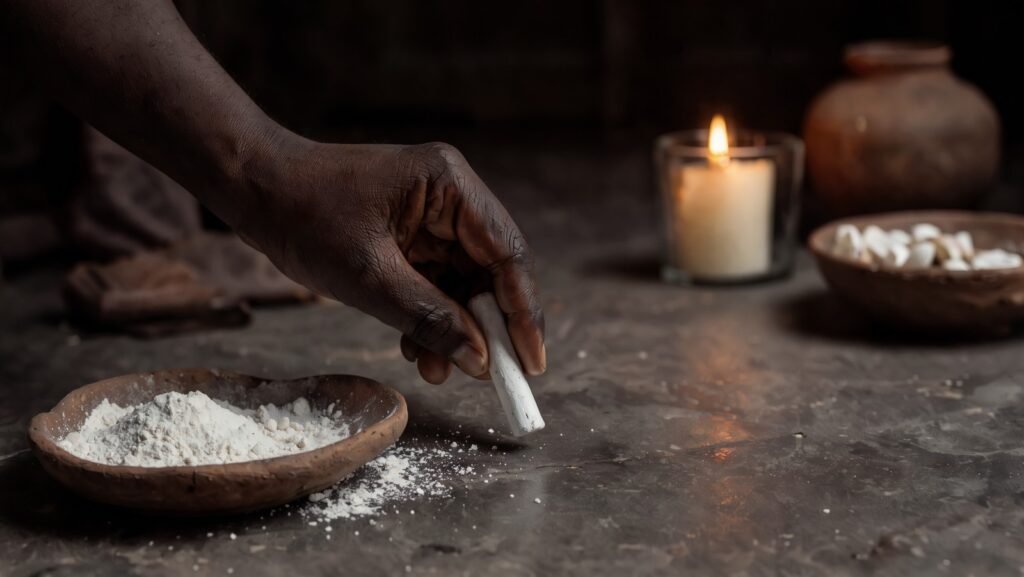
A patipemba is a sign that is drawn. It is traced on the ground with chalk or with powder, and it is a conduit. The work it does is to call.
Drawn on the ground
A patipemba is not a word and it is not a picture. It is laid down on the floor before the work begins, and what it is for is the calling.
A house that is about to do something draws the sign first. The drawing is part of the preparation, and it is how the spirits and the energies are told what is being asked for. A white candle burns beside it while the work is done.
What it is for
A patipemba is a conduit to call upon the Mpungu and other spirits and energies. It is drawn to carry out a purpose that is named and specific, and the purpose is decided before a hand touches the chalk.
A house does not draw one to have it on the floor. The work a house does begins with what is drawn, and the drawing is aimed at the thing it has come to do.
What they are drawn for
The purposes are ordinary ones. A sign is drawn to open a way, to protect a person or a place, to clean something that has been carried too long, or to settle a matter that has been argued with by others.
Nothing is drawn for show, and a sign that was drawn for one purpose is not reused for another.
The cosmogram underneath
The Dikenga cosmogram appears to serve as the base for the patipemba, though there are variations and the signs differ from house to house. The cosmogram is the clock the tradition reads a life by, and it carries four moments with a color for each.
Sunrise is joy and hope, and it is black. Noon is the physical power of men, and it is red. Sunset is the first humans, and it is white. Midnight is spiritual power and the beginning of everything, and it is yellow.
The books are not valid
Books on patipemba do exist and they can be bought. None of them are valid. Nobody verified what is printed in them, none of them come from a lineage, and there is no one standing behind the signs they show. Money spent on them is money wasted.
A house holds the signs that belong to it, and those signs are not for sale. Two houses that draw for the same purpose will not draw the same figure.
The sign does nothing on its own
This is the part that matters more than any other. A person who has not been authorized to draw a sign can trace it on the floor, and it will be inactive. The symbol can be correct and the sign still does nothing.
What a sign needs is authorization. Initiation is the usual way it is granted, and the two are not the same thing. Some patipemba are reserved for levels of initiation higher than the first, which is the plain proof that the access comes from authorization and not from the ceremony by itself. Elders describe the knowledge as the keys, and a drawing without the keys is chalk on a floor.
How the signs are kept
The knowledge of the signs is not written down where anyone can read it. It passes from a Tata or a Yaya to the people they bring in, and a house that holds an unbroken lineage holds the signs that belong to it.
An initiate is expected to memorize the signs. Notes are permitted, and the memory is what the elders count on after the first year.
Sigil or patipemba
People who come looking for a Palo Mayombe sigil are looking for this. A sigil and a patipemba are the same question asked in different words, and the word the tradition uses is patipemba.
The sign is given
A patipemba is not something to copy off a page. A drawn sign that is not yours to draw is worth nothing in your hand. This page explains the sign. It does not print one. The sign is given, and it is given with the knowledge that makes it work.
Where it starts
Which Mpungu walk with a person is not decided by the person. It is determined by divination, and a reading is where that gets settled. Let the tradition speak.