Kobayende is the Mpungu who is the essence of life and death itself. He is the transporter of souls into the afterlife, he is called Tata Nfumbe, the father of spirits, and his color is purple.
Beyond the seven
He is not one of the Seven African Powers. He stands well beyond them. The seven are the ones all three branches agree on and the ones most widely known, and Kobayende is a larger figure than the group he is usually filed beside.
Where the Mpungu sit relative to every other order of spirit is set out on the cosmology page.
The spellings of his name
His name is written more than one way. Kobayende, Kubayende, Cuballende and Coballende all name the same Mpungu, and a reader who has only seen one of those forms has not been reading about a different god.
Tata Nfumbe, the father of spirits
Tata Nfumbe is the second name he answers to, and it means the father of spirits. Of the names he carries, it is the one that says the most about what he is.
The essence of life and death
Both halves are his, life and death together. He is the essence of both, and the two are not separate things where he is concerned.
He carries the souls across
He is the transporter of souls into the afterlife. In the Teremene, the four parts run in an order. Centella reaps the soul. Kobayende carries it across. Lucero and Sarabanda escort the body to its final resting place and lay it to rest.
His part is the crossing. Once the soul has been taken it has to be carried, and he is the one who carries it.
He and Lucero work together
He and Lucero are close, and they work closely together. They are two different Mpungu with two different jobs. What one opens, the other carries, and a house that works with either of them is working with both.
He gave humanity the patipemba
He gave humanity the secrets of how to draw the sigils known as patipemba. That knowledge came from him, and it is how a firma or a Nganga gets marked.
The dogs are his messengers
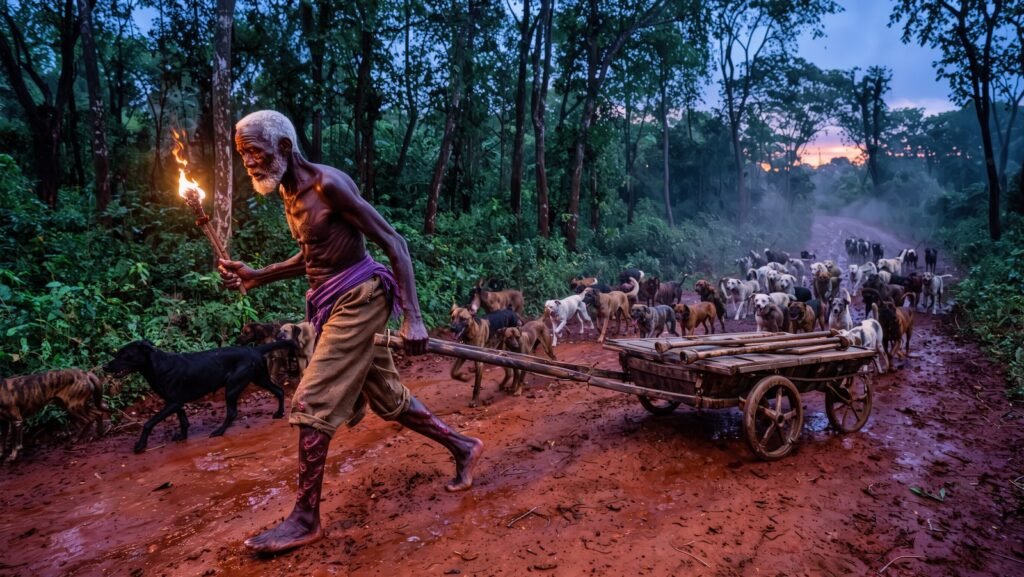
Dogs belong to him, and he keeps them as his messengers.
Sickness and healing
He is the spirit of sickness and he is the spirit of healing, and the two belong to the same Mpungu for a reason. Sickness is as much his territory as death is.
Where he is found
In nature he is routinely found in the forest and at the ceiba, and anywhere there is a concentration of the dead or of dogs. Burial grounds, battlefields and the country around packs of wild dogs are all his.
He is also found at hospitals and wherever there are sick people.
What he takes
He takes popcorn that has already been popped, canary seed sweets, cigars and dry white wine.
He speaks for those who have no voice
He is benevolent, and he is often the object of admiration. He is the Mpungu of the sick, the poor and the destitute, and that is the company he keeps. The reason he is admired sits above his other work: he speaks for those who have no voice.
Purple, and how he appears
His color is purple. He appears as an old man, in the same way Tiembla Tierra does.
The name Lazarus
The Mpungu were never fused with the Catholic saints. Nothing was merged and nothing was blended. The veneration of the Mpungu was hidden behind the saints, because carrying them openly was not survivable, and the saint was the cover that made it possible.
Kobayende is the one carried behind Lazarus. When a person keeps a Lazarus statue, or speaks the name Lazarus, what they are working with and speaking to is Kobayende. The saint is the cover. He is who is being addressed.
How a house finds him
A house does not assume which Mpungu a person carries. A reading is how that gets settled, and it is the same reading that shows what a Mpungu is asking for.