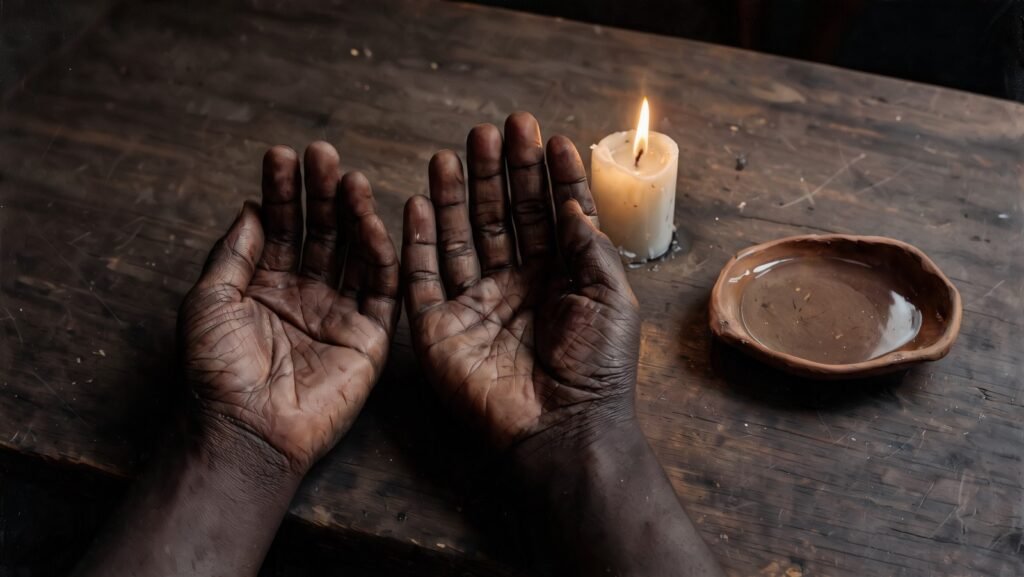
Prayer in this tradition is a conversation. You speak with your spirits, you speak with the Mpungu, and you speak with God. That is the whole of it.
Prayer is a conversation
Prayer is not a formula and it is not a performance. It is a person speaking to the spirits they belong to, to the Mpungu they walk with, and to Nzambi above all of it. The speaking is the thing.
A conversation goes both ways as well. What comes back may arrive as a thought that was not yours, a shift in how your body feels, or a thing another person says to you at the right moment.
You do not need a special language
You do not need a language you were not raised in. You do not need words you had to look up. The spirits already know you, and they are not waiting on vocabulary.
A ceremony is a different matter. Prayers in a ceremony are said in Kikongo, and some of them have been said that way for centuries, which belongs to the ceremony and to the house that keeps it. Speaking with your own spirits is not a ceremony, and it does not wait on the language of one.
You do not need a special hour
There is no hour to wait for and no day to hold out for. Prayer is not scheduled. Speak when you have something to say, and speak when you have nothing to say and only want to sit with them.
Anyone can pray
Praying does not require permission. A person who has never been to a house, never been read and never been initiated can speak to their own spirits, to the Mpungu and to Nzambi, and nothing is missing from it.
Being given the prayers of a house is a different thing, and those come with initiation.
What to say
There is no script to learn before the first one. Say what you came to say. If you do not know how to open, open with the truth about where you are, and let the rest follow from that.
A person who speaks with their spirits regularly will tell you it gets easier, and that the early awkwardness is not a sign that anything is wrong.
What is said in a ceremony
A house has prayers of its own, and they are said inside a ceremony rather than printed on a page like this one. A Misa is prayer said together, with one person taking it up and then another and the room answering.
Those prayers belong behind the door they are said behind. What does not belong behind a door is the part set out above, which is that a person can speak to their spirits without asking anyone first.
The prayers an initiate is given
An initiate is given prayers to learn, along with everything else that comes with being brought into a house. The learning is expected.
Reading them out of a notebook is not a fault. A person who has been in the tradition for years and still has not committed them to memory is the one the elders will ask about.
Who the prayers go to
Nzambi is the word for God in this tradition. Nzambi is the creator of all existence, and the prayers of Palo Mayombe are addressed to Nzambi, to the Mpungu, and to the spirits of the dead.
The Mpungu are the ones a person speaks with most often, and which of them walk with a given person is not something that person decides.
Where it starts
If you want to know which spirits walk with you, that is not something to guess at. It is determined by divination, and a reading is where that gets settled. If what you are looking for is a ceremony rather than a page, the work of a house is set out on the services page and the Misa has its own. Let the tradition speak.