People who come looking for a Palo Mayombe altar are looking for the Nkisi room. Altar is the word most people arrive with, and it is the word this page uses so that the search finds it. What the word points at in this House is a room.
What people mean by the altar
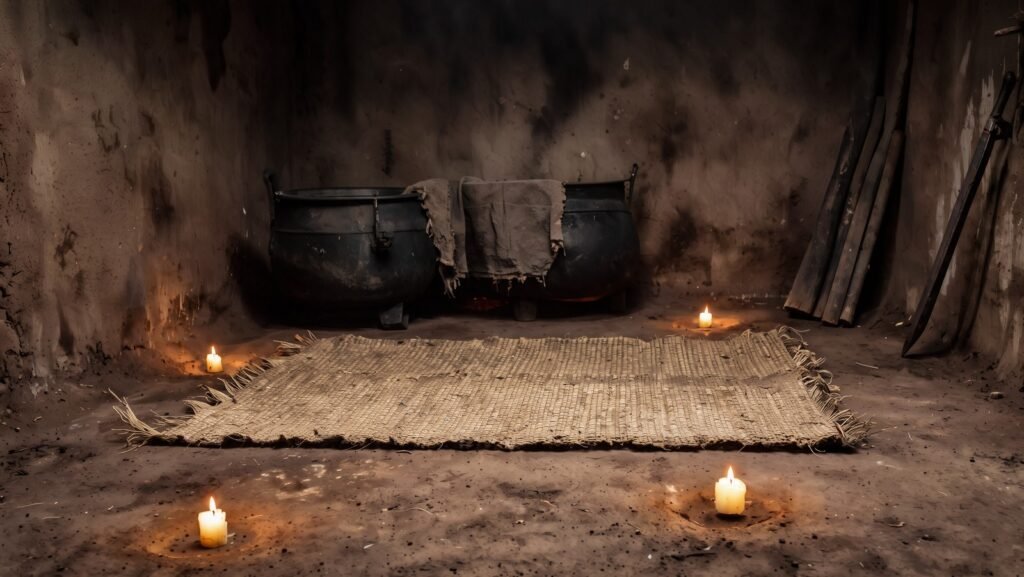
A house in Nkisi Malongo keeps a room for the Nganga and the other consecrated objects. That room is where the work is done, and it is what a person is describing when they say altar.
The word is loose rather than wrong. An altar is furniture a person stands in front of, and this is a room a person enters. The difference matters, because the arrangement inside the room is doing something.
What stands in the room
The Nganga stands at the center. Everything else is placed in relation to it.
Around it a house keeps the Mpungu in the objects that belong to them. The mound of Lucero Mundo is one of those. There are Nkisi, and there are the tools the work is done with, among them the palos and the machete.
The mat on the floor
A straw mat is unrolled in front of the Nganga when the work is done. That is where a person sits, and it is where a reading happens with the shells.
The firma is drawn on the floor
Work in the room often begins with a firma traced on the floor in chalk or powder, under the Nganga. The sign is the part of the room that changes, and it changes with the work. What a patipemba is is set out on its own page.
Why nothing is placed at random
Every object has a position, and the position is part of what the object is doing. Nothing in the room is there to fill a space.
The bóveda is a different practice
The two are confused with each other constantly and they are not the same thing. A bóveda belongs to Espiritismo. It is a table, and on it sit water glasses in rows, a white candle and a crucifix. It is where the spirits of the dead are spoken with, and a Misa in this House is held around one.
The Nkisi room is the other thing. The Nganga stands at the center of it, and that is the room the work of this tradition happens in.
What the room is used for
A reading, a cleansing, a working for protection, a Misa. The room is where all of it happens, and it is not arranged for a visitor to look at.
A private room
The room is not a public space and it is not shown to visitors. What happens in it happens with the people of the house, and the objects in it belong to that house.
Other words for it
People arrive at this page carrying different words for the same thing. Altar, shrine, Nganga room, Nkisi room and prenda room all get used. The Nkisi room is the closest of them, and Nganga and prenda both name the vessel at the center rather than the room around it.
Where the arrangement comes from
The arrangement comes from the lineage. It is learned in the house, by being in the room and by being taught, and every house follows the foundation laid by the Kongo ancestors while working it in its own way.
Where it starts
Which Mpungu walk with a person, and what a person needs, is not guessed at. It is determined by divination, and a reading is where that gets settled. If you would rather read before you do anything else, the books page is the place to start. Let the tradition speak.